Miles Wang并非无名之辈。作为OpenAI核心研究团队的成员,他深度参与了大语言模型的开发工作。如今选择进入药物研发领域,表面上是一次职业转身,背后则是AI技术应用逻辑的深刻变化。随着ChatGPT等通用模型进入成熟期,部分顶尖研究者开始寻求将AI能力嵌入到更为具体、商业壁垒更高的行业中。药物发现正是这样一个典型场景:传统的候选分子筛选动辄耗费数年,而AI可在数月甚至数周内完成虚拟筛选与分子设计,直接缩短研发周期、降低数亿美元成本。这种“AI for Science”的模式,正在重构生物医药的研发范式,也自然成为人才与技术溢出的新方向。
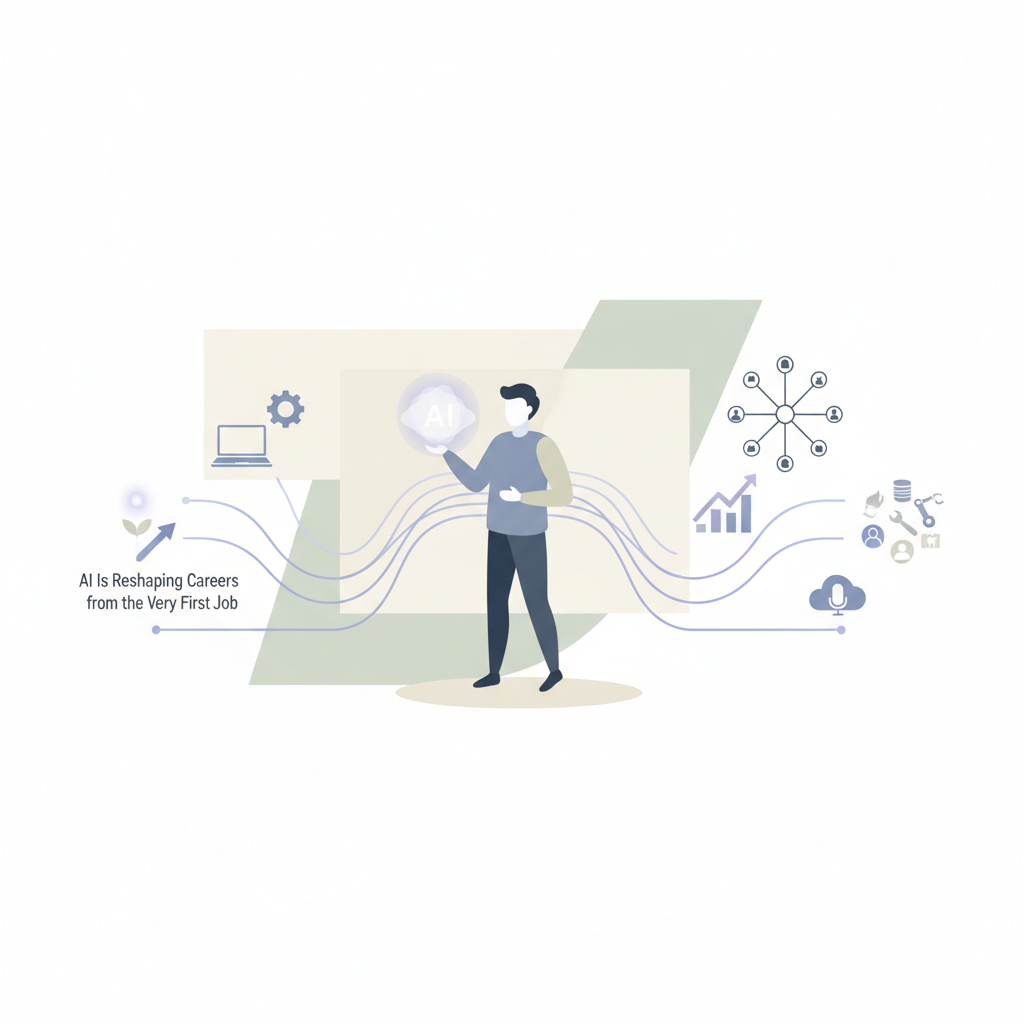
The entry-level job, long the rite of passage for new graduates, is undergoing a transformation that few could have predicted a decade ago.
The entry-level job, long the rite of passage for new graduates, is undergoing a transformation that few could have predicted a decade ago. Artificial intelligence is not just automating routine tasks; it is fundamentally redefining what it means to start a career. For HR professionals, business leaders, and the millions of remote workers navigating this shift, the implications are profound: the skills that once guaranteed a foot in the door are being replaced, and the entire talent lifecycle—from hiring to development—must be reimagined.
The Disappearing Training Ground
Traditionally, first jobs were built on a scaffolding of repetitive, rule-based tasks. Junior analysts crunched numbers, assistants managed calendars, and customer support reps followed scripts. These roles gave newcomers the opportunity to learn an organization’s culture, build professional networks, and develop situational knowledge—all while making only low-risk mistakes. AI now handles many of these tasks with speed and precision, from generating reports to scheduling meetings and even resolving customer queries. The consequence is that the classic entry-level position is shrinking—or in some cases, vanishing entirely. Companies can no longer expect to hire for rote work and then gradually upskill employees over years. Instead, the very first job is becoming a role that demands immediate judgment, creativity, and the ability to work alongside intelligent machines. For remote teams, this challenge is amplified because new hires often lack the informal, in-person cues that once helped them parse ambiguity.
Skills Over Credentials: A New Hiring Playbook
This shift is forcing HR teams to rethink their hiring criteria. A degree from a prestigious university says little about a candidate’s ability to collaborate with an AI agent or to interpret data that a model has already synthesized. Forward-thinking organizations are moving toward skills-based hiring, where assessments and practical problem-solving carry more weight than resumes. Analysis from platforms like LinkedIn shows that the half-life of technical skills is shrinking rapidly—what is cutting-edge today can become outdated in months—while human-centric abilities like communication, adaptability, and emotional intelligence are holding their value. For remote and hybrid roles, these soft skills become even more critical, as employees must navigate digital collaboration tools and maintain cohesion without face-to-face interaction. The interview process itself is evolving: instead of asking about past experience, recruiters are presenting scenarios that require candidates to demonstrate how they would use AI to solve a problem or make a decision. This democratizes opportunity by focusing on potential rather than pedigree, but it also demands that companies invest in robust, unbiased assessment methods.
Rethinking Onboarding and Development in a Remote-First World
With many first jobs now fully remote, the loss of organic, in-office mentorship is another acute issue. New hires used to absorb norms and tacit knowledge by sitting next to seasoned colleagues. In a distributed environment, that informal learning evaporates, and AI tools can become both a problem and a solution. Companies are experimenting with AI-powered onboarding assistants that guide new employees through paperwork, training modules, and internal knowledge bases, providing instant answers to common questions and reducing the anxiety of the unknown. Yet there is no substitute for human connection, so successful remote onboarding programs are pairing these digital tools with structured mentorship, virtual shadowing, and regular one-on-one check-ins. The goal is to create a learning ecosystem where the first job is a launchpad for continuous growth, not a dead-end role that AI will eventually make obsolete. When done right, this model can actually accelerate professional development by exposing new hires to a wider variety of tasks and decision-making scenarios much earlier than traditional paths would allow.
Strategies for Business Leaders
What does this mean for CEOs and heads of people operations? First, job descriptions must be audited and redesigned to emphasize the human-machine partnership. Instead of listing static duties, they should articulate outcomes and the AI competencies required to achieve them—such as “able to review and refine AI-generated analysis for accuracy and bias.” Second, investment in ongoing employee development can no longer be a perk; it must be a core operational strategy. This includes not only reskilling programs but also giving employees access to the latest AI tools and the autonomy to experiment with them. Finally, organizations need to build a culture of psychological safety where admitting what you don’t know is rewarded, because the pace of change means everyone—from the newest hire to the C-suite—is constantly learning. As companies embrace skills-based, flexible hiring to meet this new reality, platforms like XMF are helping them connect with remote-ready talent that can adapt to AI-augmented workflows quickly. The organizations that thrive will be those that see the first job not as a static entry point but as a dynamic, evolving relationship between people and technology.
Originally published by XMF, inspired by publicly reported industry news.
In a striking reminder that age bias can surface even within the human resources function, the District of Columbia Water and Sewer Authorit
In a striking reminder that age bias can surface even within the human resources function, the District of Columbia Water and Sewer Authority (DC Water) has agreed to pay roughly $217,000 to settle a federal claim that it replaced an experienced HR professional with a younger employee. The settlement, announced by the U.S. Equal Employment Opportunity Commission (EEOC), highlights the legal, financial and reputational risks businesses face when hiring and firing practices are not rigorously fair.
The Case at a Glance
The EEOC’s lawsuit alleged that DC Water terminated a long-serving HR specialist – who was over 40 and performing satisfactorily – and then filled the role with a significantly younger worker. Such actions, if proven, would violate the Age Discrimination in Employment Act (ADEA), which protects individuals 40 and older from age-based employment decisions. While DC Water denied any wrongdoing, the utility opted to settle the matter, agreeing to pay $217,000 in back wages and damages and to implement additional anti-discrimination training.
The case is notable because the alleged victim was an insider: an HR professional. It shatters the assumption that personnel departments, staffed by people trained in equal opportunity compliance, are inherently insulated from bias. The settlement makes plain that organisations must examine how decisions are made at every level, including among the very people who counsel others on fairness.
Why HR Is Not Immune
Age stereotypes can be particularly stubborn in the workplace. Older employees are sometimes wrongly perceived as less adaptable, less comfortable with technology, or more expensive than their junior counterparts. These unspoken biases can influence hiring, restructuring and succession-planning discussions – even when formal policies forbid discrimination.
HR teams themselves face unique pressures. When business leaders demand transformational change or cost savings, HR may be tasked with redesigning roles and letting go of staff. Under that stress, subjective criteria can slip into evaluations: “culture fit” can become a proxy for youth, and “future potential” can discount decades of reliable performance. The DC Water settlement suggests that a seasoned HR professional was viewed through that distorted lens, to the organisation’s detriment.
Building a Bias-Free Hiring Framework
To avoid similar missteps, people leaders should embed objective safeguards into every stage of the employee lifecycle. Structured interviews, blind resume reviews and clear, measurable performance rubrics help remove gut feelings that may mask age prejudice. Documenting the business rationale behind each personnel move is equally critical; a written record forces decision-makers to articulate legitimate, non-discriminatory reasons and invites scrutiny.
Regular audits of workforce data also serve as an early warning system. Tracking the age profile of new hires, promotions and terminations can reveal patterns that are invisible in isolated cases. If a department involuntarily separates a disproportionate number of employees over 40, it’s time to investigate before a charge materialises.
Training remains essential, but it must go beyond a once-a-year compliance module. Scenarios specific to age bias – like selecting a candidate to lead a digital transformation – should be discussed openly, so managers learn to recognise and counter their own assumptions. As platforms like XMF help organisations streamline recruitment and workforce planning, integrating bias checks and audit trails directly into those digital workflows becomes both simpler and more impactful.
The DC Water settlement is a $217,000 figure, but the true cost of age discrimination is much higher: lost institutional knowledge, diminished team morale and a damaged employer brand. For HR leaders, the lesson is clear: the profession that champions fairness must live by the same standards it promotes.
Originally published by XMF, inspired by publicly reported industry news.