Recruiters are caught in a paradox. AI tools can now source, screen, and rank applicants in a fraction of the time it took a human team just
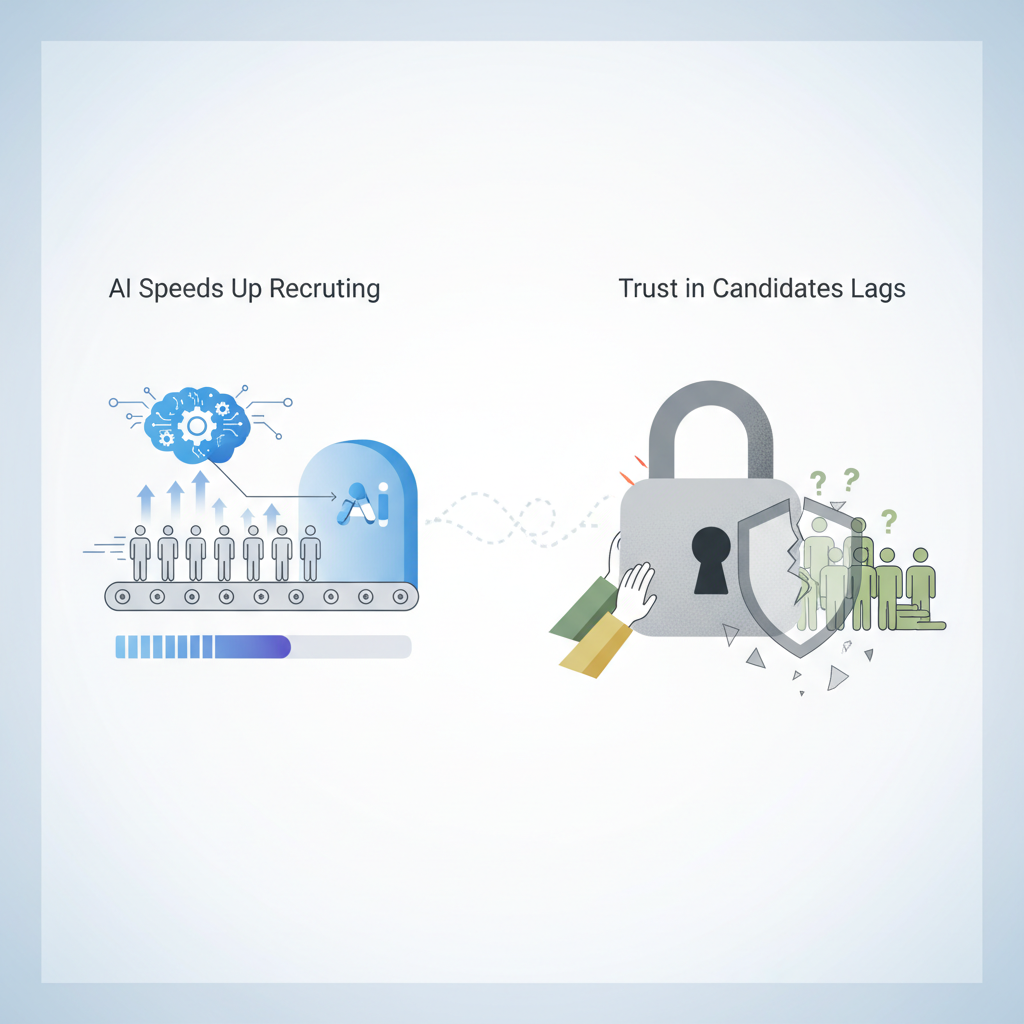
Recruiters are caught in a paradox. AI tools can now source, screen, and rank applicants in a fraction of the time it took a human team just a few years ago. Yet according to a fresh HR Dive report, many talent professionals say that speed has not made them more confident in the people they shortlist. If anything, it has made the final human judgment more important—and more exposed.
The finding points to a maturing but uneasy relationship between hiring teams and AI. Automation has removed the most tedious parts of recruiting: searching databases, parsing resumes, drafting outreach, scheduling interviews. But the core question—whether a candidate will actually perform well in a specific role, team, and culture—remains stubbornly hard to automate.
The Speed Trap in AI-Assisted Hiring
AI recruitment tools are no longer a novelty. They can screen thousands of applications, identify passive candidates, and even conduct preliminary video interviews. For remote and hybrid roles, where a single job posting can attract applicants from dozens of countries, that capacity is essential. Talent teams simply cannot read every resume carefully, and AI helps them focus on the most promising profiles.
The problem is that speed creates its own pressure. When sourcing becomes effortless, the volume of candidates entering the pipeline increases. Recruiters then use AI to filter more aggressively, often relying on keyword matching, inferred skills, and historical hiring patterns. This can surface people who look right on paper but have not been meaningfully assessed for judgement, communication, adaptability, or the specific challenges of distributed work.
As a result, many recruiters report a gap between algorithmic output and their own conviction. They may reach a shortlist faster, but they still feel the need to double-check, re-interview, and manually verify the qualities that matter most. In some cases, the AI confidence ranking does not match the recruiter’s read of a candidate’s context, career transitions, or motivation.
Why Faster Sourcing Doesn’t Equal Better Hiring
There are several reasons why speed has not translated into trust. First, AI models are trained on patterns from past hiring data, which can reflect bias, incomplete information, or simply the preferences of a previous era. A candidate with an unconventional background—common among remote workers, career changers, and people from emerging markets—may be ranked lower even when they are highly capable.
Second, AI screening often struggles with context. Two candidates can have the same job title but very different responsibilities. A freelance project may look like a gap. A remote-first career may involve asynchronous collaboration, self-management, and digital communication skills that are not easily captured in a resume. Recruiters know this, so they hesitate to trust a score that cannot explain why someone was selected or rejected.
Third, confidence is a human emotion as much as a statistical outcome. A recruiter gains confidence by talking to a candidate, sensing how they think, and imagining them in the team. AI can narrow the field, but it cannot replace that final intuitive check. When that check happens late in the process—after AI has already filtered out many candidates—the risk is that good people were lost before a human ever saw them.
Building Confidence Without Slowing Down
None of this means recruiters should abandon AI. The more realistic path is to redesign the workflow so that AI handles what it is good at, while humans make the final call earlier and with better information. That might mean using AI for candidate discovery and administrative tasks, but keeping human review on borderline candidates. It could also mean asking AI tools to explain their recommendations, not just produce a ranking.
For remote and hybrid employers, the stakes are especially high. When you cannot meet a candidate in person, you rely more heavily on structured interviews, work samples, and references. AI can help coordinate those steps, but it should not be the only gatekeeper. A candidate who communicates well asynchronously, manages their own time, and has experience with distributed teams may not match a keyword profile—yet could be exactly who the role needs.
Some teams are experimenting with human-in-the-loop pipelines where AI suggests, but does not decide. Recruiters review a broader, more diverse pool and then use AI to schedule, summarize, and compare candidates. The goal is not to replicate the old slow process, but to combine algorithmic reach with human accountability.
The current moment is a warning against treating recruitment as a purely technical problem. AI has made hiring faster, but confidence in candidates will only improve when humans remain responsible for the final judgment. For flexible staffing platforms such as XMF, that balance is essential: use AI to match skills across a global talent pool, but never let the algorithm replace a recruiter’s professional judgment.
Originally published by XMF, inspired by publicly reported industry news.
Artificial intelligence has become a common tool in talent acquisition, promising to reduce the time recruiters spend searching for candidat
Artificial intelligence has become a common tool in talent acquisition, promising to reduce the time recruiters spend searching for candidates. Yet a persistent gap is emerging: even as AI helps recruiters find people faster, many remain uncertain about the quality of the candidates those systems surface. This tension, highlighted in a recent HR Dive report, captures a critical challenge for modern hiring teams. Speed without trust does not automatically produce better outcomes.
The issue is especially relevant for companies that hire remote or hybrid workers, where recruiters may never meet a candidate in person and must rely heavily on digital signals. AI can scan thousands of profiles in seconds, but if the resulting shortlist feels unreliable, recruiters end up adding extra screening layers. The time saved in sourcing can simply shift to later stages, eroding the promised efficiency.
The appeal of AI-driven sourcing
AI recruiting tools excel at volume and pattern recognition. They can parse resumes, analyze skills, and match candidates to job descriptions faster than any human team. For high-volume roles or niche technical positions, this capability is transformative. Recruiters can expand their reach beyond the usual networks, surface passive candidates who never applied, and identify people whose non-traditional backgrounds actually fit the role.
Many talent teams have adopted these tools to reduce time-to-fill and lighten administrative workloads. Instead of manually scanning hundreds of applications, recruiters can focus on conversations with a curated set of candidates. In principle, that should improve both efficiency and candidate experience. In practice, however, the technology’s limits are becoming more visible.
Why confidence has not kept pace
One reason is that matching algorithms often rely on keywords and historical data. A candidate may use the right terms but lack the context that makes a strong hire. AI can infer that someone has experience with a particular software tool, but it cannot easily assess how well they used it, whether they led a project successfully, or how they collaborate in a distributed team. These nuances matter, especially for remote roles where communication and self-management are essential.
Recruiters also lose confidence when AI produces false positives. A profile that looks strong on paper may collapse after a short phone screen. If this happens often, recruiters begin to doubt every AI recommendation. Unlike a human colleague, an AI system usually cannot explain why it ranked one candidate above another. That lack of transparency makes it hard for recruiters to defend their shortlists to hiring managers or to adjust the process based on feedback.
Bias is another concern. If an organization’s past hiring data skews toward certain backgrounds, an AI model trained on that data may reproduce the same patterns. Recruiters who are actively trying to build more diverse pipelines may find AI-generated shortlists too homogeneous. Without careful monitoring, the tool can quietly reinforce the very problems the company is trying to solve.
Building a more reliable AI-assisted process
The goal should not be to reject AI in recruiting, but to use it as a first-pass assistant within a structured human review process. AI can gather, sort, and rank candidates, but final decisions should rest on clear, role-specific criteria evaluated by people. Recruiting teams can strengthen confidence by auditing AI outputs regularly, not just to see who was selected but also who was excluded and why.
Transparency from vendors also helps. When recruiters understand how a model scores candidates, they can use that information more effectively and catch errors earlier. Training matters too. Recruiters need to know what AI can and cannot do, so they can treat its suggestions as hypotheses rather than verdicts.
For remote and flexible work environments, structured evaluation is even more important. A distributed team cannot rely on in-person intuition to compensate for weak shortlists. Clear rubrics, standardized interview questions, and centralized candidate data can help maintain consistency. Some HR platforms, including XMF, are building workflows that combine automation with human review stages, helping teams keep that balance. The aim is not to remove judgment from hiring, but to give recruiters better information and more time to apply it thoughtfully.
Ultimately, AI in recruiting is a tool, not a replacement for professional judgment. The organizations that benefit most will be those that treat speed as a starting point and invest in the human oversight that turns faster sourcing into better, more confident hiring decisions.
Originally published by XMF, inspired by publicly reported industry news.