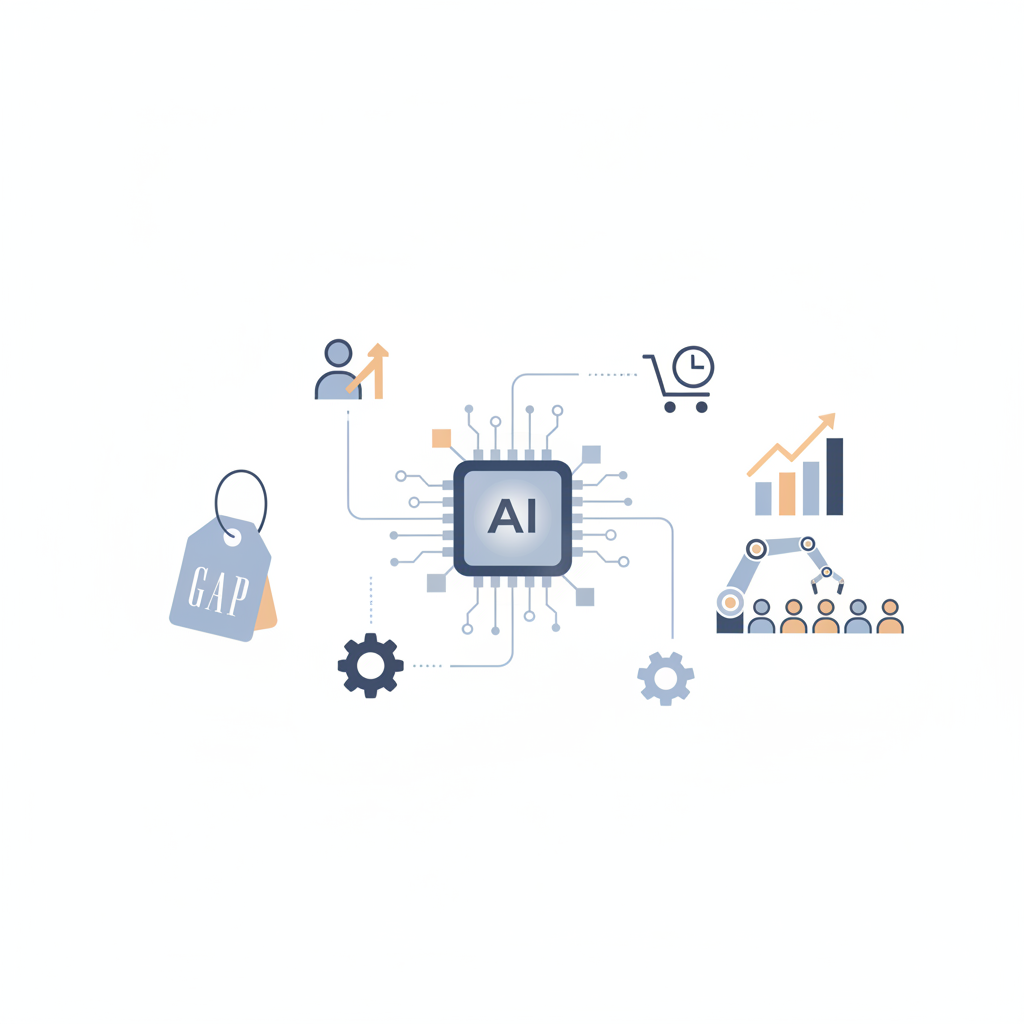
近日,美国服装零售集团 Gap(盖璞)宣布在假日购物季到来前正式推出一款人工智能(AI)招聘工具,用于加速门店和仓储岗位的候选人筛选。这一动作并不令人意外——每年第四季度是零售业最繁忙的用工高峰,临时店员、仓库分拣、客服等岗位需求量激增,而传统招聘流程往往难以在几周内消化海量申请。Gap 选择此时上线 AI 工具,本质上是在“时间”和“人效”上做文章。
假日季用工压力倒逼自动化
美国零售业在假日季通常会新增数十万个临时岗位,招聘窗口却很短。过去,门店经理需要手动翻阅简历、逐一致电安排面试,效率低下且容易漏掉合适的候选人。AI 工具可以 7×24 小时处理申请,自动完成关键词匹配、基础资格筛查和初步排序,把初筛时间从天级压缩到分钟级。对 Gap 这样拥有多个品牌的大型零售集团来说,标准化的初筛能力还能减少不同门店之间招聘标准不一的问题。
AI 招聘不是“全自动”,而是“人机协作”
尽管 Gap 并未披露所有技术细节,但这类工具的常见功能包括简历解析、候选人自动评分、聊天机器人预筛、面试日程协调等。需要强调的是,AI 主要负责“粗筛”,最终是否录用仍由招聘经理和门店负责人决定。Gap 方面也提到会保留人工复核环节,以降低算法偏见带来的风险。例如,如果训练数据偏向某一类背景的候选人,AI 的排序结果可能产生不公平,因此人机协作是现阶段更稳妥的落地方式。
对中国零售与灵活用工的启示
中国零售、餐饮和物流行业同样面临节假日用工波峰,双十一、春节前的临时用工需求巨大。Gap 的做法提供了一个可参照的样本:把标准化岗位的海量初筛交给 AI,让 HR 团队把精力放在面试体验和入职培训上。不过,中国灵活用工市场更加分散,不少企业仍依赖人力中介或线下渠道,AI 工具要真正落地,需要与本地招聘平台、灵活用工系统深度打通。对于聚焦远程办公和灵活用工的平台来说,这也意味着新的机会——例如小蜜蜂云工作这类平台,未来可以借助类似的 AI 初筛能力,帮助企业在用工高峰期更快匹配远程兼职或项目制人才。
Recruiting has rarely been simple, but the current moment feels different. Hiring teams are caught between contradictory pressures: more app
Recruiting has rarely been simple, but the current moment feels different. Hiring teams are caught between contradictory pressures: more applicants than ever, harder-to-fill roles, tighter budgets, and a growing expectation that AI will do more with less. The result is a profession under strain, where recruiters often spend more time screening noise than building relationships. Understanding the main forces at play is the first step toward a more sustainable hiring process.
A flood of applications with less usable signal
One of the most visible trends is volume. The normalization of remote work and one-click applications has made it easier for candidates to apply to dozens of roles in a single session. At the same time, generative AI tools allow job seekers to tailor resumes and cover letters in seconds or even auto-submit applications. For recruiters, this means an inbox that is fuller but not necessarily more useful. A role that once attracted 100 relevant applicants may now draw 1,000, many of them only loosely qualified or generated with little human review.
This dynamic pushes recruiting teams toward automated screening filters, which create their own problems. Strong candidates with non-traditional backgrounds can be filtered out for missing keywords, while polished AI-generated applications can look identical to genuine ones. Recruiters are left spending extra time verifying what is real and relevant, rather than engaging with the people behind the applications.
Moving role requirements and growing skills gaps
A second trend is the mismatch between what roles require and what available candidates can demonstrate. Organizations are reshaping jobs around AI, data literacy, and cross-functional ownership. A marketing role may now expect familiarity with automation platforms; an operations role may ask for experience managing AI-driven workflows. These requirements are still fluid, making it difficult to write precise job descriptions and evaluate candidates consistently.
Recruiters feel this mismatch acutely. They are asked to find people who may not exist in large numbers yet, or to assess skills that hiring managers cannot define clearly. When a search drags on, recruiters absorb the frustration from both sides: candidates who feel the process is confusing and managers who feel the talent pool is insufficient. The result is longer time-to-hire and a heavier cognitive load on recruitment teams.
Lean teams and rising burnout
Recruiting teams have been through waves of layoffs and hiring freezes, leaving fewer people to manage the same or greater workload. In many companies, talent acquisition is expected to be a strategic partner while operating with the staffing of a cost center. Recruiters are also expected to cover more roles, support more hiring managers, and respond to more candidate inquiries with fewer colleagues to share the load.
Burnout has become common. Recruiters report spending more time on administrative coordination and less on high-value conversations. When hiring demand rises again, teams may not have the internal capacity to move quickly. Some organizations are responding by simplifying hiring stages and consolidating platforms, but adoption is uneven.
The tools gap and fragmented workflows
A final trend is the growing complexity of the recruiting tech stack. Recruiters are asked to master an expanding set of point solutions: sourcing tools, assessment platforms, scheduling software, ATS updates, and AI assistants. Each tool promises efficiency, but together they can create fragmented workflows that make the job harder rather than easier. Information gets scattered, processes overlap, and recruiters lose time switching between systems.
This tools gap is especially frustrating because the promise of AI in recruiting is usually tied to speed and automation. In practice, many teams are still in an experimental phase, adopting new tools faster than they can integrate them. Without clear workflows and better data flow between systems, AI becomes another layer of work rather than a genuine time saver.
None of these trends exists in isolation. High application volume makes skills mismatches more visible; lean teams and fragmented tools make both harder to manage. For HR leaders, the takeaway is not to simply demand more from recruiters, but to redesign processes around clearer role definitions, better screening signals, and fewer disconnected tools. Remote-first staffing platforms such as XMF can reduce some administrative burden, but they work best when paired with honest conversations about what each role truly needs. Until then, recruiters will keep navigating an unusually difficult market with limited resources.
Originally published by XMF, inspired by publicly reported industry news.
The arrival of generative AI has forced organizations to rethink a question that used to be simple: should entry-level employees be trusted
The arrival of generative AI has forced organizations to rethink a question that used to be simple: should entry-level employees be trusted with powerful new tools before they have learned the fundamentals? Toshiba’s Chief Human Resources Officer offers a counterintuitive answer. Rather than shielding early-career workers from AI, companies should encourage them to use it more—not less.
The logic challenges a common assumption. Many managers worry that junior staff will use AI to skip essential learning, generate superficially polished work, or mishandle sensitive information. Those concerns are real, but they may be leading companies in the wrong direction. In a workplace where AI is becoming part of nearly every workflow, early-career employees need to build fluency now, not after they have spent years working without it.
Why entry-level is the right place to start
Entry-level roles are often filled with tasks that generative AI can accelerate: drafting emails, summarizing documents, researching vendors, preparing spreadsheets, screening candidates, or creating first drafts of reports. If a new employee is told not to use AI for these tasks, they may learn slower, not faster. That is because the value of the task often lies not in producing the first draft, but in reviewing it, improving it, and understanding what makes it good.
A junior analyst who uses AI to draft a report still has to verify the data, check for errors, sharpen the argument, and ensure the recommendations align with business goals. A junior recruiter who uses AI to summarize interviews still has to decide which signals matter and which details require a follow-up conversation. These are exactly the judgment skills organizations want to develop.
The danger of protecting junior employees from AI
When organizations restrict AI use among early-career workers, they may create an invisible divide. Experienced employees become more productive with AI, while newer employees lose opportunities to experiment, fail safely, and learn how to direct these tools. Over time, that gap can become a serious talent problem. Companies may find that their most senior staff are comfortable with AI, but the people who will lead in ten years have spent their formative years avoiding it.
This also affects hiring and retention. Candidates increasingly expect to use modern tools at work. If an entry-level position feels unnecessarily manual, top talent may look elsewhere. More importantly, if internal employees do not develop AI literacy early, organizations may be forced to hire externally for roles that could have been filled by their own people.
From blanket restrictions to guided responsibility
The answer is not to remove all guardrails. Sensitive data, client confidentiality, and quality standards still require clear policies. But those policies should be designed as training wheels, not permanent barriers. HR leaders can help by creating guided AI use cases, showing new hires what responsible prompting looks like, and building review checkpoints into early work.
Managers can ask entry-level employees to document which AI tools they used, compare multiple outputs, and explain their edits. This turns AI use into a visible learning process instead of a hidden shortcut. Performance conversations can then focus on judgment, verification, and improvement rather than simply whether a task was completed.
For HR teams, the message is clear: entry-level AI literacy is not a future concern. It is a core part of workforce development now. The organizations that teach new hires how to work with AI—rather than forbidding it—will likely build stronger pipelines for the next generation of managers and specialists.
For global organizations, the challenge is consistency. An entry-level employee in one office should not have different AI expectations than a peer in another region or time zone. Clear policies, accessible training, and regular feedback loops can help HR leaders make AI literacy a shared standard rather than a local preference.
Originally published by XMF, inspired by publicly reported industry news.