

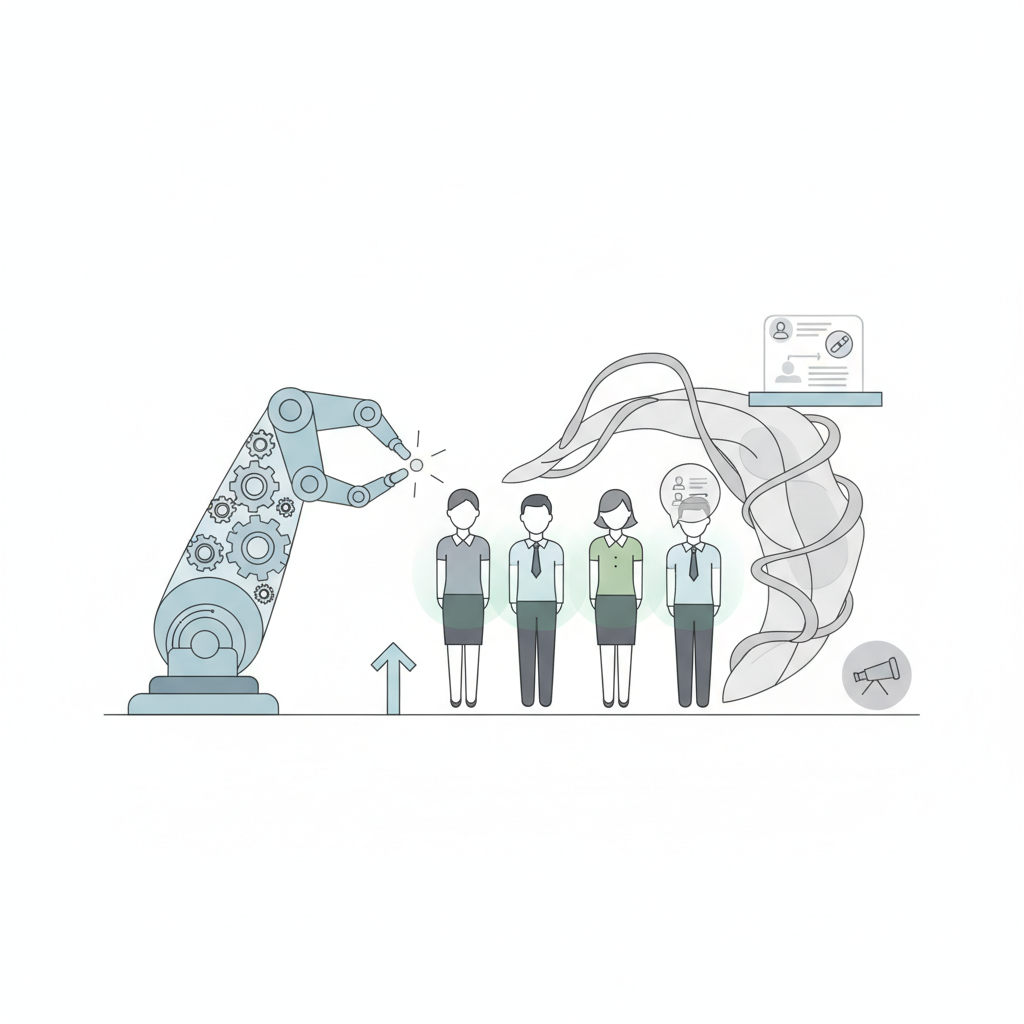
Generative AI is often presented as a great equalizer in knowledge work. Junior employees can suddenly produce documents, analyses, and drafts that once required years of supervised practice, while senior professionals use the same tools to accelerate their established workflows. A three-month field experiment with 133 patent attorneys, however, reveals a more complicated picture. AI assistance did improve immediate performance across the board, and the least experienced attorneys gained the most. But when the tool was removed, those junior gains largely disappeared, while senior attorneys retained much of what they had learned. The findings are a cautionary tale for any organization that expects AI to transform productivity without weakening professional development.
Why junior professionals gained the most
For a junior patent attorney, drafting claims, searching prior art, and anticipating examiner objections are demanding tasks that normally require repeated cycles of feedback and revision. AI assistance can act as a real-time scaffold: it suggests structures, flags missing elements, and helps produce competent first drafts far more quickly. In the experiment, junior attorneys experienced the largest immediate productivity gains because the tool compressed much of the trial-and-error learning curve. This effect is especially attractive in remote and hybrid teams. Managers may see new hires become productive sooner, and distributed colleagues can work from cleaner drafts without relying on constant synchronous guidance from busy seniors.
The retention problem after the tool is switched off
The more troubling finding is what happened when AI support was removed. Junior attorneys who had relied heavily on the tool struggled to maintain their earlier performance, while senior attorneys, who already possessed firm mental models of legal reasoning, continued to perform well. This suggests the juniors had not simply learned faster; in many cases, they had offloaded core reasoning to the software. Without the AI scaffold, they had fewer internal reference points to guide their judgment. The distinction matters because a tool that improves output today can quietly erode the very capabilities that make a professional valuable later. The study does not argue that AI is useless, but it does challenge the assumption that short-term productivity gains automatically translate into long-term skill acquisition.
A sharper risk for remote and hybrid teams
Remote work already places more weight on written communication and self-directed learning. Informal development moments, such as overhearing a senior colleague reason through a difficult case or asking a quick question after a meeting, are less frequent when teams are distributed. AI tools can fill some of that gap by offering instant guidance, but they can also mask the need for genuine mentorship. A junior employee working alone may produce polished work with AI assistance while never realizing that critical judgment calls are being made by the model rather than by them. Over time, organizations may find that their remote junior staff are highly productive on standard tasks but unprepared for novel, ambiguous, or high-stakes situations where AI is unavailable or unreliable.
How HR leaders can protect long-term growth
HR leaders and team managers should treat AI rollout as a skill-development challenge, not merely a productivity initiative. One practical step is to create deliberate no-AI exercises: core tasks that junior employees must complete from first principles before turning to a language model. Another is to require brief written explanations of how AI output was evaluated and changed, which encourages active review rather than passive copying. Mentor check-ins are also valuable, particularly when they ask early-career employees to explain their reasoning aloud and defend their edits. The goal is not to ban AI—such a policy would be unrealistic and counterproductive—but to ensure that junior professionals build the foundational judgment they will need when tools fail, change, or disappear. For remote-first organizations and talent platforms such as XMF, the study is a useful reminder to pair AI adoption with deliberate strategies for long-term skill preservation.
Originally published by XMF, inspired by publicly reported industry news.
 Likes 0
 Save
 Copy Link

 沪公网安备 31011702008840号
 Electronic Business License