


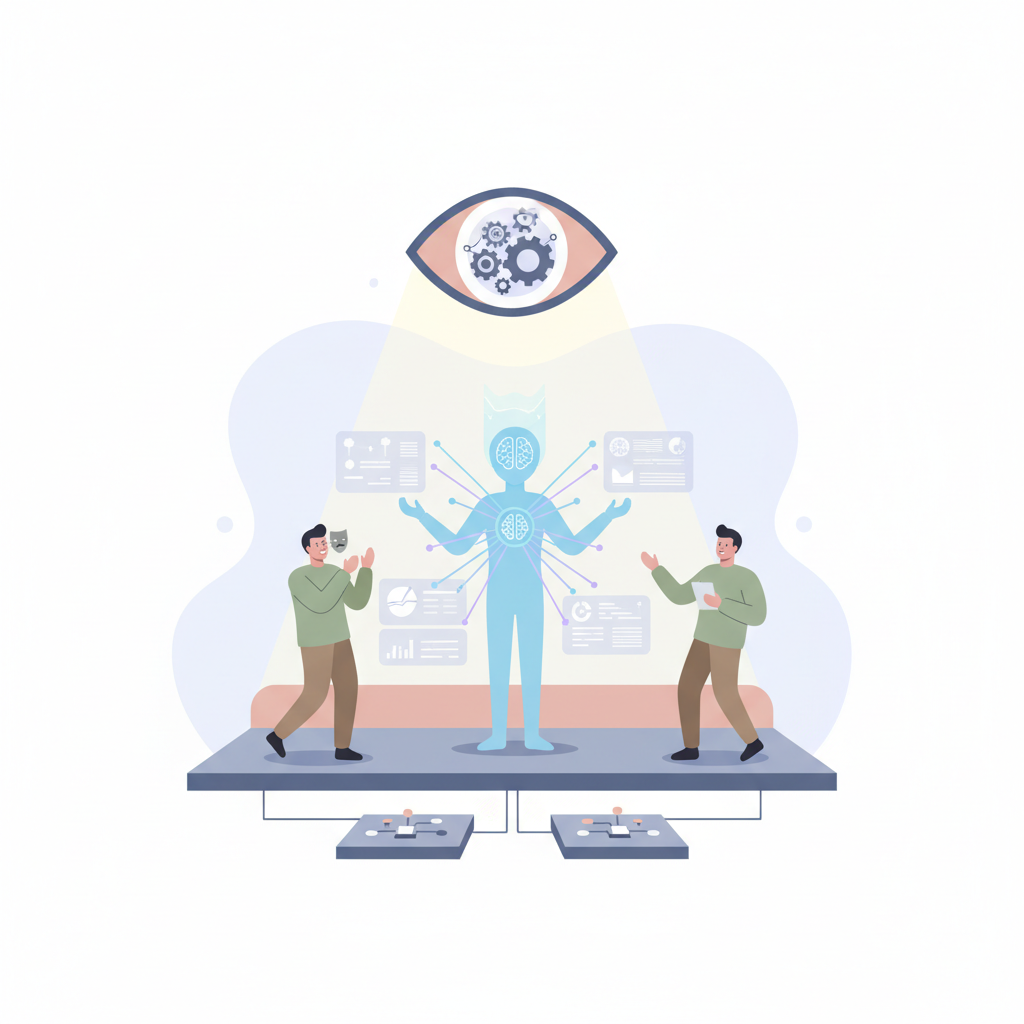
The rapid spread of generative AI tools has created a strange dynamic in many companies. Leaders want to show they are innovating; employees want to show they are adapting. In between sits a growing amount of performative work, where AI is used not because it produces better results, but because the act of using it has become a signal of being modern, efficient, or promotion-ready.
Recent reporting from HR Dive highlights that employees themselves are describing this phenomenon. As roles shift and job descriptions blur, some workers say they feel expected to demonstrate AI fluency even when a task would be faster or more accurate without it. The result is a new form of workplace theater: visible, often unnecessary AI use performed for managers, peers, or performance reviews.
Why performative AI is spreading
Performative AI does not emerge in a vacuum. It is often a response to mixed signals from the top. A company may announce an AI-first strategy, set usage targets, or ask teams to integrate AI into workflows before the underlying problems have been defined. When leaders reward demonstrations of tool adoption rather than measurable improvements, employees learn quickly that showing AI use matters more than the quality of the result.
Role ambiguity makes this worse. As organizations restructure teams and experiment with new AI-enabled positions, many employees are unsure what good performance now means. They may not know whether their value will be judged by output, speed, creativity, or simply by how well they align with the latest technology narrative. In that uncertainty, appearing AI-competent can feel like a safer bet than quietly doing excellent work without it.
There is also a social dimension. In hybrid and remote environments, visibility is already a challenge. When colleagues share AI-generated summaries, brainstorm with chatbots, or post about their AI workflows, others may feel pressure to keep up. Some of this is genuine learning; some is a quiet competition for visibility. The line between adoption and performance blurs when workers believe their tech usage is being watched, even if no one has explicitly said so.
What performative AI looks like in practice
The signs are often subtle. An employee may run a routine email through an AI assistant before sending it, not to improve the message but to be able to say AI was used. A team may add an AI step to a process that previously worked well, creating extra review work without improving accuracy. In meetings, people may highlight the tools they used rather than the decisions they made. The common thread is that AI becomes a display of effort rather than a driver of value.
This behavior can carry real costs. It adds unnecessary steps to workflows, erodes trust when employees feel they must perform rather than be honest, and makes it harder for organizations to learn which AI applications actually work. If managers cannot distinguish meaningful adoption from theater, they may invest in the wrong tools, reward the wrong behaviors, and overlook employees who are using AI quietly and effectively.
From AI visibility to AI value
Addressing performative AI does not mean discouraging AI use. It means changing the incentives around it. Leaders can start by defining concrete problems before selecting tools. Instead of asking how to use AI more, they can ask which tasks are being done repeatedly and why they take so long. When AI is tied to a specific bottleneck, its value becomes easier to measure and much harder to fake.
Managers should also reward outcomes rather than tool mentions. A performance review that asks whether an employee used AI will encourage theater; a review that asks how the employee reduced cycle time, improved accuracy, or handled more complex work will encourage substance. If AI contributed to those outcomes, it will show up naturally in the result.
For remote and hybrid teams, the challenge is especially relevant. When managers cannot see how work is produced, they may be tempted to use tool usage as a proxy for engagement. That creates exactly the wrong incentive. A more durable approach is to set clear expectations, agree on the metrics that matter, and then give people room to choose the methods that produce the best results. Some platforms, such as XMF, support this shift by helping distributed teams stay aligned around outcomes rather than performative signals.
AI adoption is not a race to be seen using new tools. It is a slower, more difficult process of finding where automation genuinely helps and where human judgment remains essential. The companies that navigate this well will not be the ones with the most AI activity; they will be the ones that learn to measure what AI actually improves, and give employees no reason to pretend otherwise.
Originally published by XMF, inspired by publicly reported industry news.
 Likes 0
 Save
Save
 Copy Link



 沪公网安备 31011702008840号
 Electronic Business License