

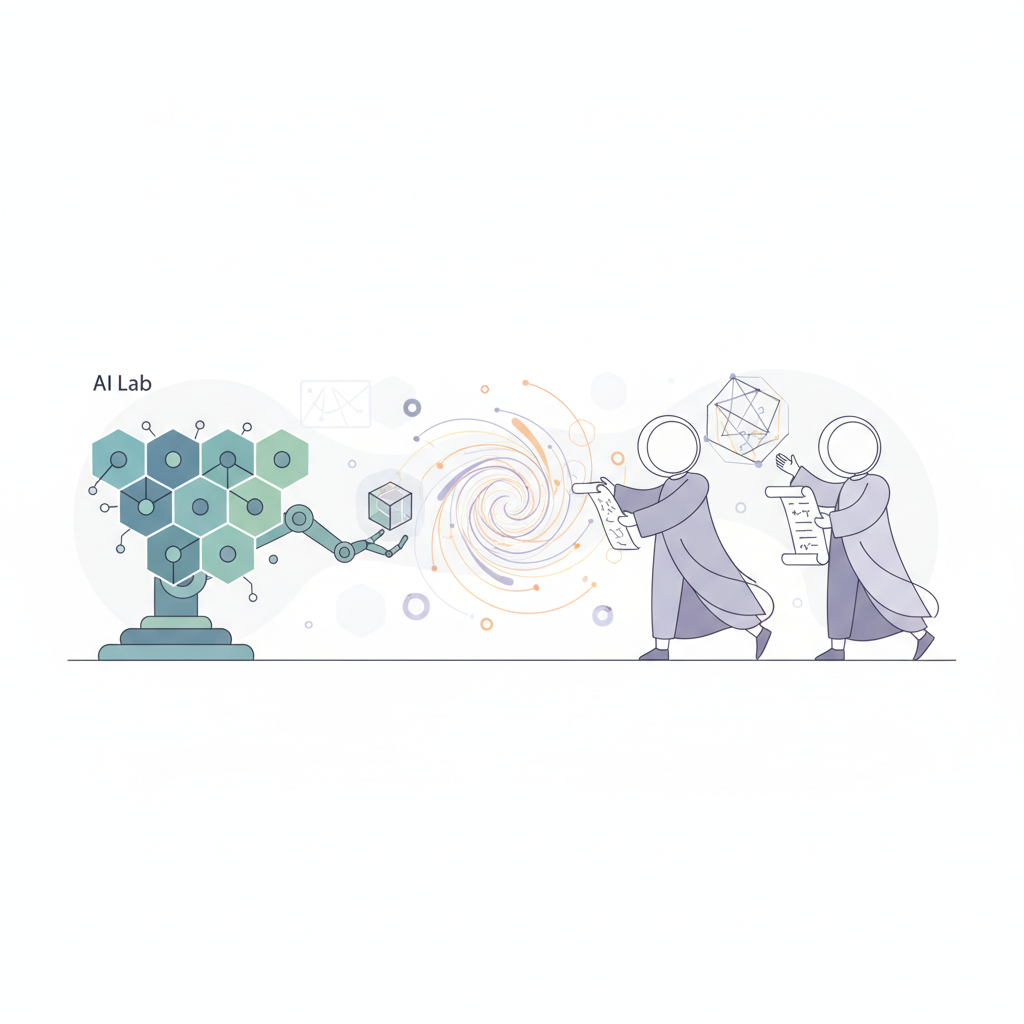
OpenAI’s escalating dispute with the mathematics community has moved beyond isolated criticism. Twenty-five leading mathematicians recently signed an open letter arguing that AI labs are threatening their intellectual work. The confrontation is not simply about technical credit; it touches on the value of human expertise, the integrity of research, and the future of specialized knowledge work as AI systems become more capable. The disagreement has implications that reach far beyond university mathematics departments.
The Core of the Dispute
At the center of the debate is a fear that advanced AI models can now absorb, reproduce, and sometimes extend mathematical reasoning in ways that bypass the traditional mechanisms of peer review, attribution, and academic recognition. Mathematicians have long operated within a culture where new results are judged by human experts, published after careful scrutiny, and linked to the individuals or teams who produced them. When AI labs build systems that can solve problems or generate proofs at speed, those human-centered processes come under pressure.
For many mathematicians, the open letter is less about rejecting AI outright and more about demanding guardrails. They argue that if AI systems are trained on decades of published mathematical literature, the field deserves transparency about how that work is used. There are also concerns about accountability: if an AI system produces a flawed proof or a misleading result, it is not always clear who should be held responsible. Those questions become urgent as AI moves deeper into research environments where errors can have real consequences.
The dispute also reflects a deeper cultural mismatch. Academic mathematicians often work on problems for years with no guarantee of success, motivated by curiosity and recognition from a small peer group. AI labs, by contrast, move at product speed and measure progress in benchmarks and commercial impact. Those different incentives make collaboration difficult, even when both sides share a genuine interest in advancing mathematics.
What It Signals for Knowledge Work
The mathematicians’ concerns are a preview of what many skilled professionals will face. AI is no longer confined to routine automation; it is beginning to operate in domains that require abstract reasoning, pattern recognition, and creative problem-solving. Lawyers, financial analysts, engineers, and medical researchers are already seeing similar tensions over data use, professional standards, and the changing definition of expertise.
For remote and hybrid teams, the shift may arrive faster. Distributed work often relies on written documentation, shared tools, and codified knowledge, which makes certain tasks more accessible to AI systems. A remote analyst who spends much of the day preparing reports, manipulating datasets, or drafting technical summaries may find that parts of that work can be automated. The challenge is not to resist the technology but to redesign roles so that human judgment, stakeholder communication, and ethical oversight remain central. This is especially true for organizations that have embraced flexible staffing, where role clarity and outcome measurement already matter more than physical presence.
Hiring and Managing Talent in an AI-Intensive Era
For HR professionals and business leaders, this dispute underscores a hiring challenge. Traditional signals such as advanced degrees or years of experience may no longer fully capture a candidate’s ability to work effectively with AI tools. Organizations need people who can interpret AI outputs, challenge flawed assumptions, and apply domain knowledge in ambiguous situations. That requires new interview methods, practical assessments, and ongoing learning programs.
It also creates an opportunity to build more resilient teams. Instead of replacing specialists, many organizations will benefit from professionals who can supervise AI workflows, verify results, and communicate them clearly to non-experts. For teams that rely on flexible or remote specialists, platforms like XMF can help surface candidates who demonstrate both deep domain expertise and the ability to collaborate with AI systems.
The mathematicians’ open letter may be one skirmish in a much larger renegotiation of how intellectual work is valued. How organizations respond—through clear policies, thoughtful hiring, and a commitment to human accountability—will shape whether AI becomes a threat to expertise or a tool that amplifies it.
Originally published by XMF, inspired by publicly reported industry news.
 Likes 0
 Save
Save
 Copy Link



 沪公网安备 31011702008840号
 Electronic Business License