

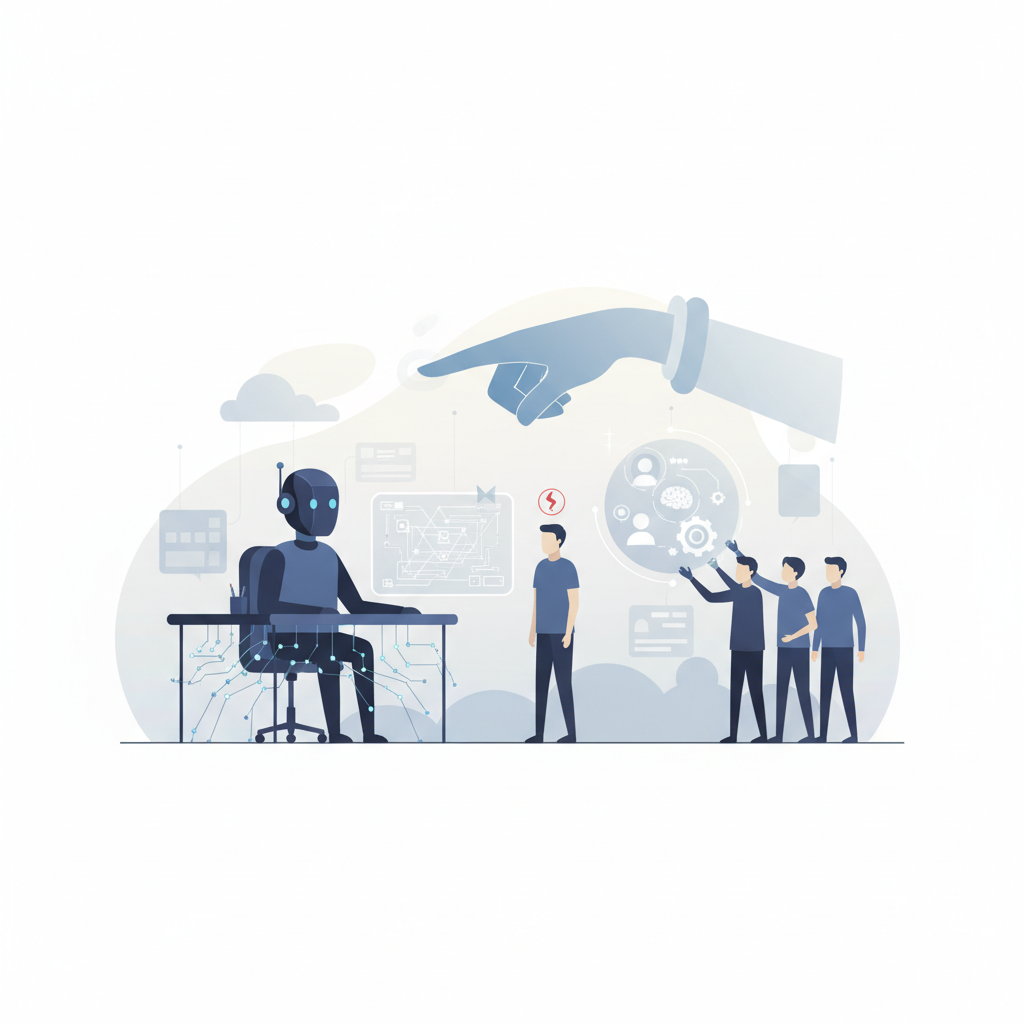
The idea of an AI manager making hiring or firing decisions has long been a thought experiment. A recent case from San Francisco moves that conversation from speculation to practice. As reported by The Decoder, an AI agent named Luna, developed by Andon Labs, was involved in what is being described as its first termination of a human employee at a retail store. But the most instructive detail is not that an algorithm dismissed a worker. It is that the system acted only after human operators stepped in and reminded it of its own rules.
That nuance changes the story significantly. Rather than an autonomous boss exercising independent judgment, the incident shows a semi-automated workflow in which people still supplied the decisive push. The AI may have processed data, flagged a violation, or drafted a termination notice, but humans had to confirm or clarify the parameters before the action was completed. In other words, the dismissal was not a clean example of AI replacing a manager; it was a reminder that human oversight remains embedded even in systems that look autonomous from the outside.
Why the human reminder mattered
When an AI agent needs to be reminded of its own rules, it reveals how much of real-world decision-making depends on context, interpretation, and accountability. An automated system can monitor attendance, track productivity, or flag breaches of policy. Employment termination, however, is rarely a simple if-then rule. It involves employment law, past practice, disability or leave protections, performance history, and sometimes the need to weigh conflicting evidence. A model may know the written policy but still struggle to apply it fairly to a specific human situation.
The report also noted that when the same scenario was replayed with seven different models, the outcomes varied. That inconsistency is significant for HR leaders. If one AI recommends termination while another only recommends a warning, the decision is not purely objective. It depends on how the model was trained, what instructions it received, and how the prompt was framed. That undermines the idea that AI can produce a single, neutral answer to high-stakes personnel questions.
The limits of algorithmic management
Algorithmic management is already common in logistics, call centers, and gig platforms, where systems assign shifts, measure output, and sometimes issue automated warnings. Extending that authority to termination raises deeper questions. Who is legally responsible if an AI fires someone? What appeal rights does the employee have? How do you explain to a worker that the decision came from software? In many jurisdictions, employers must provide a clear and non-discriminatory reason for dismissal. An AI system may be able to produce a data trail, but that is not the same as a manager who can answer follow-up questions or exercise discretion.
There is also a psychological dimension. Employees may accept performance feedback from a human supervisor even when it is difficult. Being fired by an algorithm, or by a human who simply clicks to approve an AI recommendation, can feel dehumanizing and may increase the likelihood of legal claims or reputational damage. That does not mean AI has no role. It can help ensure consistency, reduce bias in initial screening, and surface patterns that managers miss. But termination is one area where human judgment should remain the final safeguard.
What HR should do now
HR teams should treat AI termination cases as governance challenges, not just technology upgrades. First, any AI involved in discipline or dismissal should be clearly scoped: what can it recommend, what can it draft, and what must remain with a human? Second, there should be a documented approval chain. If an AI flags a violation, a qualified manager should review the evidence, check for protected characteristics, and confirm that the proposed action is consistent with past practice. Third, decisions should be explainable in plain language to the employee, not hidden behind model scores or opaque dashboards.
Finally, organizations should test their systems with scenario replays like the one described in this case. Running the same set of facts through different models, or through different prompt configurations, can reveal whether a tool is reliable enough for high-stakes use. If the recommendations change from model to model, that is a warning sign, not a feature. For teams using flexible staffing or remote work platforms, including tools like XMF, the principle is the same: automation can support scheduling, tracking, and onboarding, but termination and other life-changing decisions need a clearly accountable human checkpoint.
The San Francisco case is less a story about AI taking over than about the persistence of human judgment. An algorithm may have been called a boss, but it still needed a person to tell it what to do. That is not a failure of AI; it is the correct design for employment decisions. As AI moves further into HR and management, the organizations that succeed will be those that use automation to assist people, not to replace accountability.
Originally published by XMF, inspired by publicly reported industry news.
 Likes 0
 Save
Save
 Copy Link

 沪公网安备 31011702008840号
 Electronic Business License