

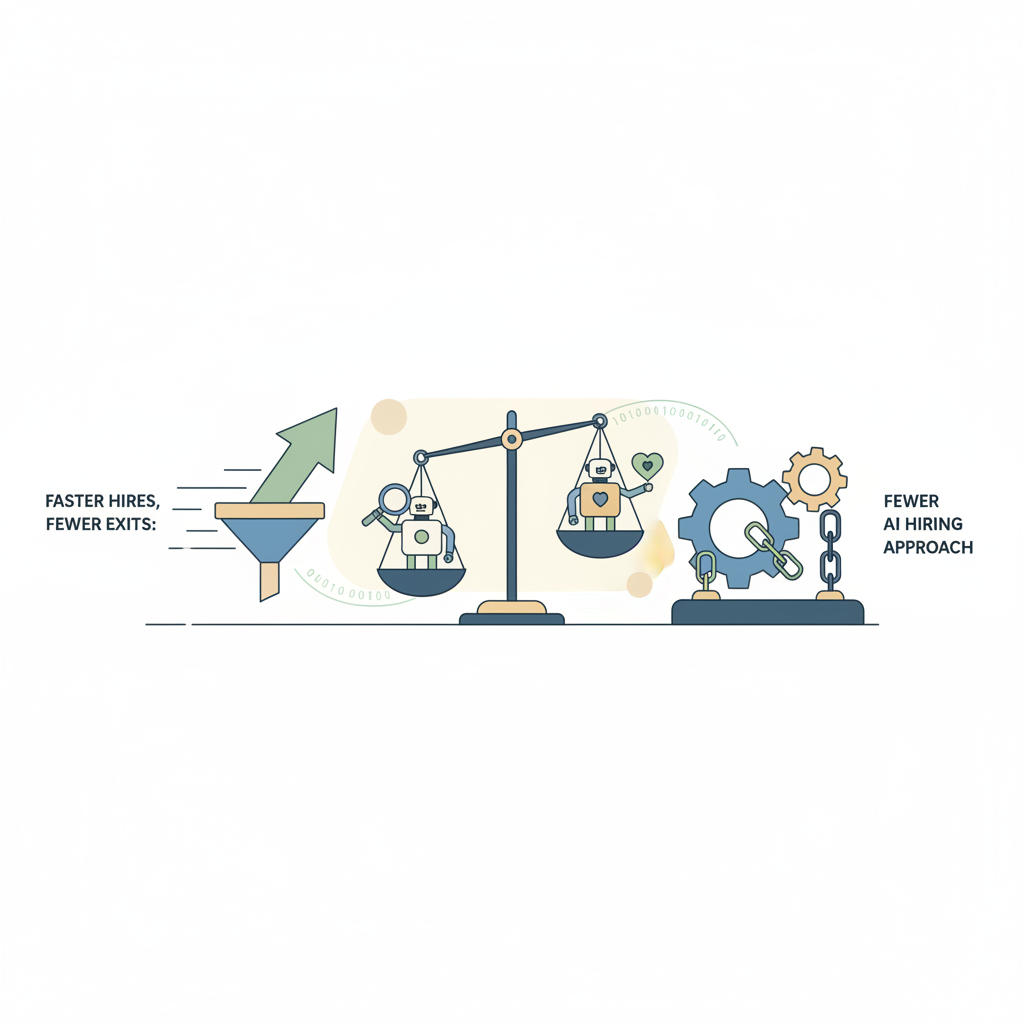
The rise of artificial intelligence in recruitment has created a strange divide. Some HR teams treat AI as a magic solution for high-volume hiring, while others fear it will replace the judgment that turns a good candidate into a great employee. Fortitude Re’s experience suggests a more practical middle path: use AI to compress the early stages of talent acquisition, but keep human decision-makers firmly in control of who gets an offer.
Denise Nichols, people officer at Fortitude Re, describes a playbook that uses AI to handle sourcing, screening, scheduling, and initial candidate communication. The result, according to the company, has been a faster hiring cycle and fewer early exits. That matters because speed alone is not enough. If hiring accelerates but retention suffers, the process has failed.
Where AI delivers the strongest returns
The biggest gains in talent acquisition come from repetitive, high-volume tasks. AI can parse resumes, identify candidates whose skills match a role, draft outreach messages, and coordinate interview times. That frees recruiters to spend more time with promising candidates and hiring managers. Fortitude Re used this approach to redesign talent acquisition around recruiter capacity rather than simply replacing recruiters.
Crucially, the company did not automate the final hiring call. AI ranks and recommends, but a human reviews shortlists, conducts interviews, and makes the offer decision. This distinction prevents the common pitfall of letting an algorithm make choices it cannot be accountable for. It also keeps candidates from feeling like they are being processed by a machine from first touch to final decision.
Why fewer early exits is the real test
Many hiring metrics focus on time-to-fill or cost-per-hire. Those numbers can look impressive even when new employees leave within months. A better test is whether hires stay, perform, and feel they understood the role before accepting. Fortitude Re’s focus on fewer exits suggests that AI can improve the quality of the match, not just the speed of the process.
When AI handles initial screening consistently, candidates may receive faster responses and clearer expectations. That reduces ghosting and frustration. It also allows recruiters to ask better interview questions because they are not buried in administrative work. The human conversation becomes more substantive, which helps both sides assess fit more accurately. A faster process that still feels personal is more likely to produce a hire who stays.
A practical playbook for HR leaders
HR leaders considering AI should start with a specific pain point rather than a broad transformation. For Fortitude Re, the pain point was a slow, inconsistent hiring process. The fix was not a chatbot to replace recruiters; it was a set of tools that gave recruiters more leverage. Leaders should ask: Which tasks consume the most time without adding judgment? Which candidate interactions are most prone to delay? Where is the data already available?
It is also essential to respect transparency. Candidates should know when they are interacting with an AI system and when a human will take over. The goal is not to hide the technology but to use it to reduce waiting and improve communication. That builds trust, which directly influences whether a new hire stays.
For remote and flexible work environments, the stakes are even higher. A distributed hiring process can feel impersonal if it is only a series of automated messages. Technology can help coordinate across time zones and talent pools, but the final decision still needs a human touch. Platforms like XMF, which support flexible and remote staffing, reflect this broader shift: efficiency matters, but so does the quality of the relationship between employer and candidate.
The Fortitude Re example is not a story about replacing people with software. It is a story about giving HR teams the tools to move faster while keeping accountability where it belongs. AI can reduce the noise, but hiring is still a human decision.
Originally published by XMF, inspired by publicly reported industry news.
 Likes 0
 Save
Save
 Copy Link

 沪公网安备 31011702008840号
 Electronic Business License