

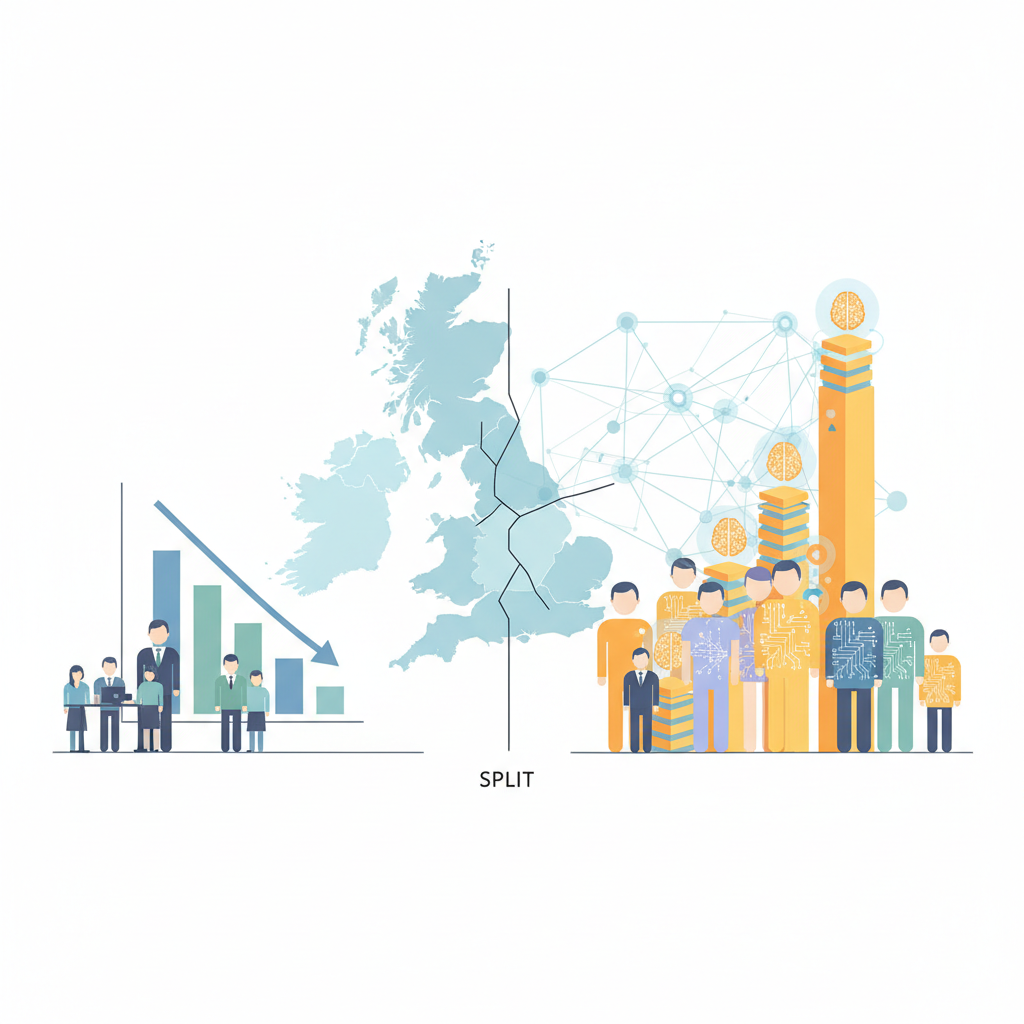
The UK labor market is fracturing along a new fault line: artificial intelligence. According to the latest data from global job site Indeed, AI now features in 9.4 percent of all British job postings, a dramatic climb from roughly 2 percent in 2023. At the same time, overall hiring is sliding in precisely the kind of knowledge work that once defined the modern office — marketing, management, business consulting, and administrative support. What we are witnessing is not a gentle reshuffling of roles but a structural split, one that is compelling HR leaders, remote‑first employers and workers themselves to rethink career strategies in real time.
The surge in AI‑related vacancies touches nearly every sector. Technology firms, financial services, retailers and even government agencies are racing to hire machine‑learning engineers, prompt specialists, AI ethicists and data‑annotation teams. These roles often command premium salaries and can be performed remotely, pulling talent into a new high‑growth orbit. Meanwhile, the very same automation wave is thinning demand for roles that rely on routine analysis, content production or procedural management — the bread‑and‑butter of knowledge workers for two decades.
A Two‑Speed Job Market Emerges
The split is not theoretical. Indeed’s data for the UK shows AI‑related postings more than quadrupling their share of the market in under three years, a trajectory that shows no sign of slowing. Behind the numbers lies a fundamental change in what organizations need: the ability to design, deploy and govern intelligent systems is rapidly overtaking the value of previously prized white‑collar skills. Job titles that barely existed in 2022, such as “AI product manager” or “LLM fine‑tuning specialist,” are now appearing daily, while postings for generic marketing coordinators or mid‑level management analysts are shrinking.
This two‑speed phenomenon is creating discomfort. On one track, AI‑fluent professionals are enjoying a seller’s market, with recruiters competing for scarce expertise. On the other, experienced knowledge workers find themselves in a cooling field where automation is redesigning the workload faster than individual upskilling can keep pace. The divide is geographic, too: regions with strong tech clusters are pulling away, while areas reliant on traditional office‑based services risk being left behind.
Knowledge Work Under Pressure
The decline in traditional knowledge‑work postings is not a headline‑grabbing collapse but a steady erosion that together paints a serious picture. Marketing, corporate communications, project management and even some legal‑adjacent roles are being re‑bundled or replaced by AI‑powered tools. When a generative AI can produce a campaign brief, a summary of market research or a first‑round contract review in seconds, the staffing model shifts from a team of generalists to a smaller group of specialists who orchestrate the tools.
For remote workers, this pressure is acute. Many of the roles that became remote‑friendly during the pandemic — content creation, customer support analysis, virtual administration — are precisely the ones that AI is now reframing. The promise of location independence remains intact, but the skills required to access it are being redefined. Professionals who do not actively incorporate AI into their daily toolkit may find their service becomes less competitive, not because they are less diligent, but because the market is moving beneath them.
What the Split Means for HR and Hiring
For HR leaders, the bifurcation demands a dual strategy. First, they must compete fiercely for AI talent, often bending traditional compensation bands and opening roles to fully remote candidates across national borders. At the same time, they need to manage the more sobering task of reskilling existing workforces while making thoughtful decisions about which roles to retain, retrain or retire.
The split also reshapes recruitment philosophy. Posting a job description and waiting is no longer enough when the hottest skills are rare. Internal mobility programs become vital — giving current employees pathways into AI‑adjacent positions through company‑sponsored training. Apprenticeships, partnerships with online learning platforms, and project‑based assignments that allow non‑technical staff to gain exposure to AI tools are moving from fringe to core HR practice.
Compliance and ethics considerations add another layer. As AI handles more of the screening, matching and even interviewing, HR teams must navigate a growing regulatory landscape. The UK government and European bodies are crafting specific rules for workplace AI, and the companies that fail to build transparent, fair systems risk both legal exposure and brand damage.
Remote Work in the New Landscape
The remote‑work dimension of this split deserves special attention. AI‑specific roles are often designed to be remote‑first, given the global scarcity of talent. In contrast, the declining knowledge‑work roles were historically remote‑friendly, too — meaning that the overall pool of remote opportunities is not shrinking; it is being repainted. The entry ticket, however, now reads “AI literacy,” not just “laptop and stable internet.”
Organizations that embrace flexible staffing models, including contingent workers and global freelancers, are better positioned to ride the wave. They can bring in AI expertise for short‑term projects while giving permanent staff the breathing space to reskill. This agile approach lessens the all‑or‑nothing risk of a sudden market tilt and keeps the workforce adaptable.
For professionals navigating this change, the message from the data is clear: regardless of job title, learning how to work alongside AI is becoming a non‑negotiable. Not everyone needs to become a data scientist, but the ability to prompt, validate and refine AI output — and to understand its limitations — is fast becoming a baseline expectation, much like spreadsheet proficiency was a generation ago.
As the split deepens, the role of platforms that connect flexible talent with emerging opportunities grows. For remote workers and employers seeking to stay nimble, environments like XMF can help match skills to the new market reality without the lag of traditional hiring cycles. Whether filling an urgent AI project need or finding a research analyst who has already evolved their toolkit, the ability to move quickly matters more than ever. The UK’s job market is delivering an unambiguous signal: the future is not about humans versus machines, but about which humans ride the wave.
Originally published by XMF, inspired by publicly reported industry news.
 Likes 0
 Save
Save
 Copy Link


 沪公网安备 31011702008840号
 Electronic Business License