

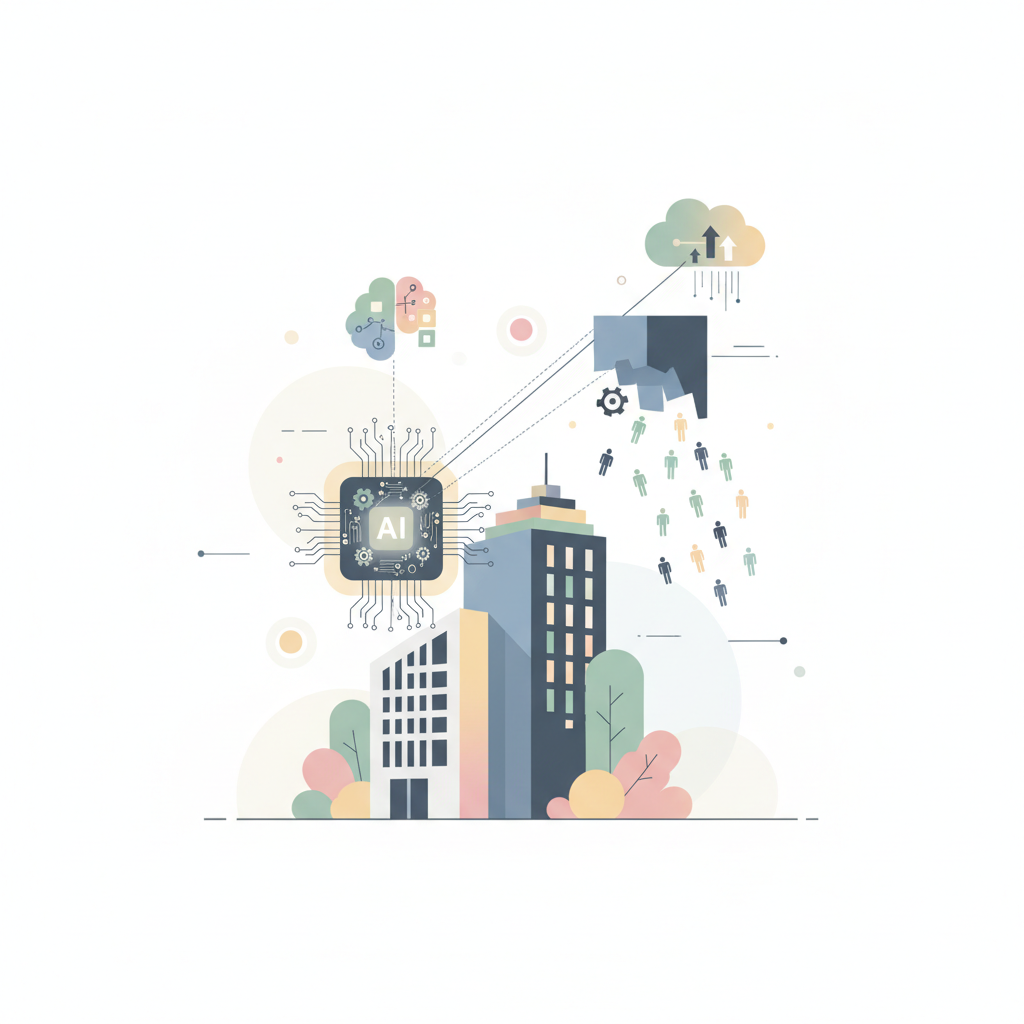
Visa's recent announcement to eliminate 2,600 positions—roughly 7% of its global workforce—sends a clear message about the accelerating integration of artificial intelligence into corporate structures. The payment giant isn't downsizing due to financial distress; rather, it is proactively reshaping its talent base to align with new technological realities. As AI tools take on an expanding array of tasks, from fraud detection to customer service analytics, the very composition of teams is shifting, prompting difficult questions about job security, reskilling, and the future of professional roles.
For HR executives and business leaders, the Visa case is a high-profile illustration of a phenomenon already unfolding across industries. Efficiency gains from AI are no longer theoretical. They are driving tangible headcount decisions, often in functions where automation can handle repetitive and data-intensive work. However, this is not a story of mere subtraction. Visa has stated that the savings will be reinvested into growth areas, highlighting a pattern in which technological disruption simultaneously eliminates some roles while creating demand for new skills.
The Shift Towards AI-Driven Efficiency
AI's impact on the workforce is multifaceted, but large enterprises are increasingly focusing on operational excellence through intelligent automation. In the payments sector, machine learning algorithms can analyze billions of transactions for risk and compliance faster than any human team, while natural language processing models streamline internal knowledge management and external communications. Visa, like many of its peers, has been investing heavily in these capabilities, and the job cuts reflect a strategic pivot rather than a reactive cost-cutting measure.
This transition challenges traditional org-chart thinking. Roles that were once considered stable—in risk assessment, report generation, and even mid-level decision-making—are being re-evaluated. The goal is not to replace all human judgment but to focus human expertise where it adds the most unique value. Consequently, efficiency becomes a competitive lever: companies that can productively weave AI into their workflows are able to operate with leaner structures and redeploy capital toward innovation and market expansion.
The Human Impact and Strategic Reskilling
When 2,600 jobs are cut, the immediate human impact is undeniable. For the individuals affected, the news represents a disruptive career inflection point. Yet, Visa is not acting in isolation. The broader trend underscores an urgent need for workforce-planning strategies that anticipate AI-driven role evolution. HR departments must now design reskilling pathways that equip employees with capabilities in AI oversight, data interpretation, and the interpersonal skills that machines cannot replicate.
Forward-looking organizations are coupling AI adoption with internal mobility programs. Instead of waiting for layoffs to become necessary, they identify at-risk roles early and offer training modules—often powered by AI themselves—to transition employees into growing fields like AI ethics, product management, and client advisory services. This approach does not eliminate all redundancies, but it softens the blow and preserves institutional knowledge. Visa's reinvestment commitment suggests that some of the freed-up resources will likely flow into new hires for these emerging disciplines, creating a churn that demands agility from both employers and workers.
Navigating the New Employment Landscape
For the international remote and hybrid work community, these developments carry both caution and opportunity. AI tools are enabling distributed teams to collaborate with greater synchronicity, yet they also make some remote-eligible roles more susceptible to automation. The key is adaptability. Professionals who continuously update their skill sets—especially in areas like AI literacy, critical thinking, and emotional intelligence—will remain valuable irrespective of their physical workplace configuration.
Organizations, too, must rethink their talent acquisition models. The traditional full-time, permanent role is giving way to more fluid arrangements that blend core employees with project-based experts and gig workers who bring specialized AI skills. This blended workforce requires sophisticated coordination, and HR leaders are increasingly turning to platforms that enable flexible staffing and rapid team scaling. In this environment, having the ability to quickly reconfigure talent can mean the difference between thriving and merely surviving a technology-driven restructuring.
As companies navigate these transformations, platforms like XMF can provide flexible staffing solutions that help balance permanent headcount reductions with on-demand expertise, ensuring that critical initiatives do not stall. Ultimately, Visa's move is not an anomaly but a signpost. The future of work is being written in real time, and it demands a mindset where both people and technology evolve together.
Originally published by XMF, inspired by publicly reported industry news.
 Likes 0
 Save
Save
 Copy Link


 沪公网安备 31011702008840号
 Electronic Business License