

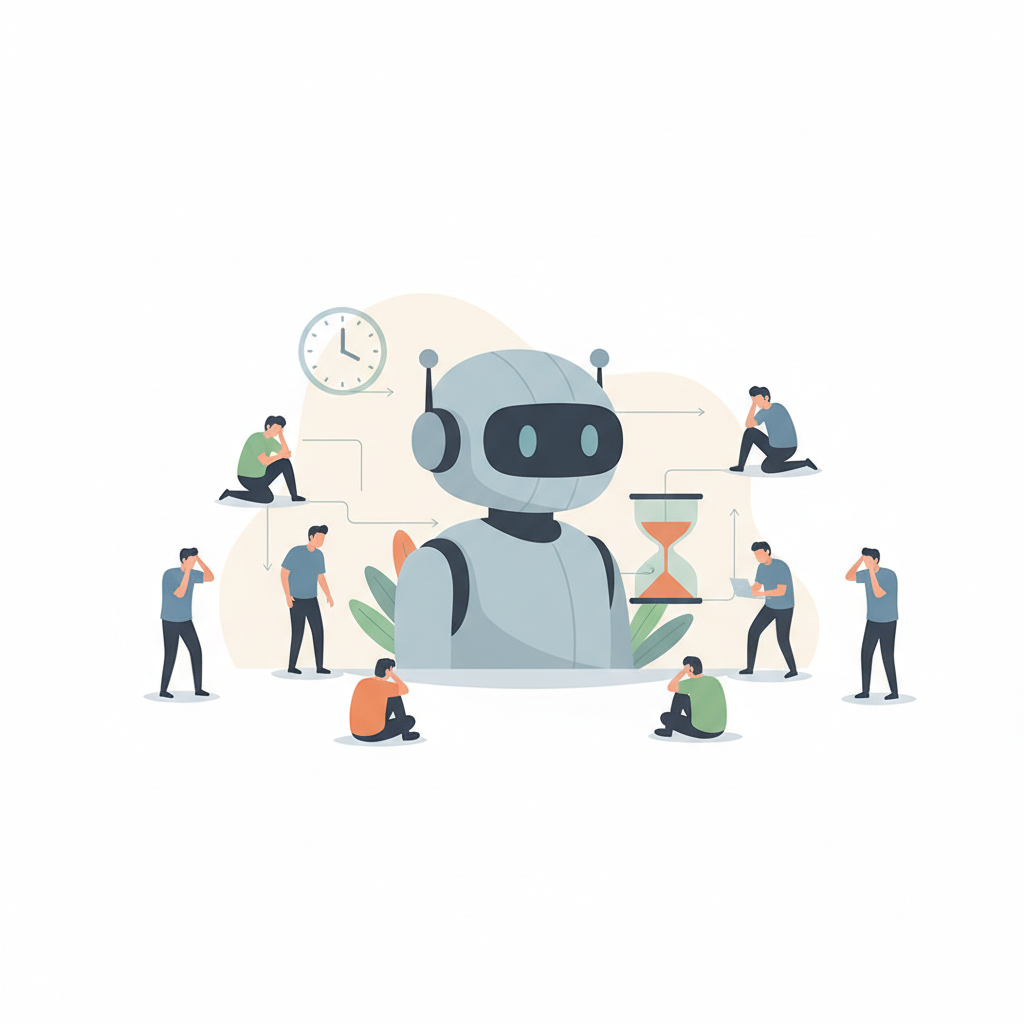
Artificial intelligence was supposed to liberate employees from drudgery, but a growing body of evidence suggests it is doing the opposite. A recent survey has put a name to a phenomenon many workers already know intimately: “botsitting.” The term describes the substantial time employees spend supervising, correcting, and double-checking the output of AI tools—time that, in many cases, rivals the hours spent on the actual task at hand. According to the data, more than six hours per employee per week are vanishing into this new digital chore, raising urgent questions about the real return on investment of workplace AI.
What Exactly Is Botsitting?
Botsitting is the act of minding an AI tool as if it were an unreliable junior colleague. An employee prompts a large language model to draft an email, generate a report, or summarize meeting notes, then painstakingly reviews every sentence for factual errors, tone inconsistencies, or outright hallucinations. The initial excitement of seeing a task completed in seconds gives way to a sobering realization: the result often requires as much editing and verification as a human first draft, but now the worker is also babysitting an algorithm’s peculiar logic.
This is not a fringe complaint. The survey found that a majority of knowledge workers now engage in botsitting regularly, and the cumulative impact is staggering. For a team of twenty people, that weekly drain translates into more than 120 hours of lost productive time—equivalent to three full-time employees doing nothing but quality-controlling machine output. Paradoxically, tools marketed as productivity boosters are eroding the very efficiency they claim to enhance.
Why Productivity Is Taking a Hit
Several factors are driving this trend. First, AI-generated content often appears confident and polished, but the underlying reasoning can be deeply flawed. A marketing report might invent statistics, a legal memo might misinterpret a statute, or a customer service response might embed subtle contradictions. Because the errors are not random typos but structurally plausible misstatements, catching them demands focused human attention. Workers quickly learn that skipping this review is risky, so they default to thorough re-inspection.
Second, many organizations deployed AI without redesigning workflows or updating governance. Employees were handed a new tool and told to “use it to save time,” but no one redefined what successful output looks like. The result is a hybrid mess: old processes with a new, unpredictable step inserted. Instead of streamlining work, AI added a layer of uncertainty that requires constant human monitoring. Finally, the metrics used to justify AI adoption—such as time to first draft—ignore the downstream effort. A first draft produced in ten seconds looks impressive on a dashboard, but if it demands forty-five minutes of rework, the net gain evaporates.
What Business Leaders and HR Can Do
Addressing botsitting starts with acknowledging it as a legitimate business problem rather than a user error. HR and operational leaders must measure total task completion time, not just the interaction with the AI tool. By tracking end-to-end cycles—from prompt to final approved output—organizations can identify where the hidden labor accumulates. This data can then inform smarter tool selection and clearer usage guidelines.
Training is equally critical. Employees need to learn prompt engineering not as a gimmick but as a discipline that reduces downstream corrections. Equally, they need permission to decide when AI is not the right solution. A short, straightforward task might be faster to do manually than to delegate to a machine and then verify. Establishing simple heuristics—such as using AI only for tasks with low reputational risk, or requiring human review only for client-facing deliverables—can claw back significant time.
Leaders should also hold AI vendors accountable. Demand transparency about error rates in specific domains, and push for features that clearly flag uncertainty in generated content. The industry term “hallucination” often trivializes what is, in fact, a fundamental reliability gap. Until AI systems can self-identify their own limitations in plain sight, botsitting will remain a mandatory overhead.
In a broader sense, botsitting reflects an immature integration of technology and human work. Platforms that help organizations design flexible, efficient workflows—and that connect teams with the right mix of skills—can be part of the solution. For instance, XMF’s flexible staffing model allows companies to bring in specialized talent for AI oversight or process redesign on a project basis, rather than burning out full-time employees with endless botsitting duties.
The irony is hard to miss. In an era when remote and hybrid work were meant to unlock unprecedented flexibility, we have invented a new category of digital drudgery. The six-hour weekly tax paid to botsitting is a signal that workplace AI is still in its adolescence. By measuring what really matters, retraining teams, and demanding better tools, organizations can turn the botsitting burden into genuine productivity gains. Otherwise, we risk automating inefficiency at scale.
Originally published by XMF, inspired by publicly reported industry news.
 Likes 0
 Save
Save
 Copy Link


 沪公网安备 31011702008840号
 Electronic Business License